
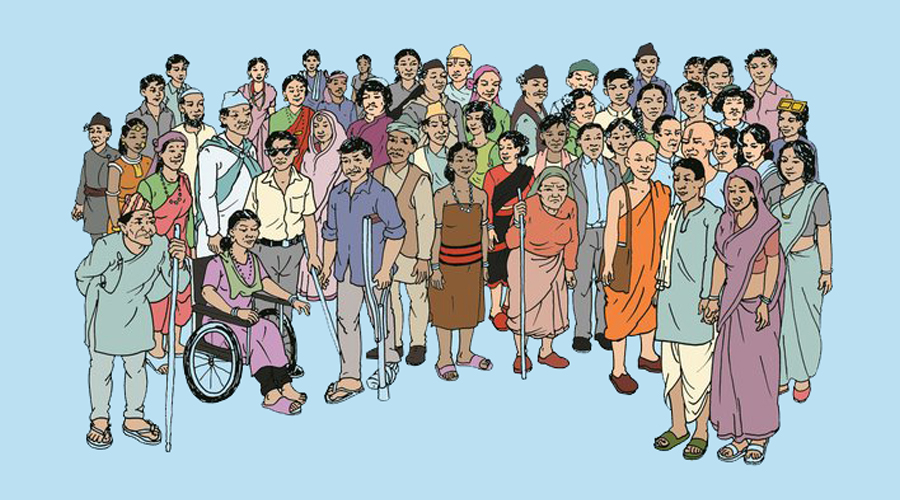
“Nepal’s Symphony of Tongues: Exploring the Nation’s Remarkable Linguistic Diversity”
Nepal, a land of unparalleled natural beauty and ancient spiritual heritage, is equally remarkable for its profound linguistic diversity. Far from being a monolingual nation, it is a vibrant tapestry woven from the threads of countless tongues, each telling a unique story of its people, history, and culture. According to the 2021 National Population and Housing Census, Nepal is home to a staggering 124 distinct languages spoken as mother tongues, reflecting an extraordinary ethnolinguistic richness.

The Anchor: Nepali as the Official Language
At the apex of Nepal’s linguistic hierarchy is Nepali, the official language and the most widely spoken across the country. A member of the Indo-Aryan branch of the Indo-European language family, Nepali serves as the primary language for government administration, education, and nationwide communication. While spoken as a mother tongue by 44.86% of the population (2021 census figures), an additional 46.2% of the total population use it as a second language, making it understood by approximately 83% of Nepalis.
Historically referred to as ‘Khas Kura’ (language of the Khas people) or ‘Gorkhali,’ Nepali’s journey to prominence began with the unification of Nepal in the 18th century under the Gorkha Kingdom. Its script is Devanagari, shared with languages like Hindi and Sanskrit, reflecting its deep Sanskrit roots. The standardization and widespread adoption of Nepali have been crucial in forging a sense of national unity amidst its vast ethnic diversity.
The Rich Tapestry: Beyond Nepali
While Nepali acts as the essential bridge, the heart of Nepal’s linguistic vibrancy lies in its myriad “languages of the nation.” The constitution of Nepal broadly recognizes all languages spoken as mother tongues within its borders, ensuring a commitment to linguistic pluralism. These languages primarily fall into two major families:
- Indo-Aryan Languages (83.07% of the population, 47 languages)
Predominantly spoken in the fertile Terai plains and the lower hilly regions, this family represents the largest linguistic group by speaker numbers. Key languages include:
- Maithili: The second most spoken language in Nepal, with 10.15% of the total population reporting it as their mother tongue (2021 census). Concentrated in the eastern Terai, Maithili boasts a rich literary tradition and is also widely spoken in parts of India.
- Bhojpuri: The third largest language, spoken by 6.06% of the population, primarily in the southern Terai districts.
- Tharu: An umbrella term for several closely related languages spoken by the indigenous Tharu people, making up 6.05% of the population. Various dialects exist across the Terai belt.
- Bajjika: Spoken by 3.93% of the population, largely in the central Terai.
- Awadhi: Primarily spoken in the western Terai, by 3.13% of the population.
- Other significant Indo-Aryan languages include Doteli (2.97%), Urdu (1.95%), Magahi (1.45%), Rajbanshi (0.46%), and various regional dialects.
- Sino-Tibetan Languages (16.59% of the population, 72 languages)
These languages, belonging to the Tibeto-Burman group, are prevalent in the mountainous and hilly regions, reflecting the strong cultural and historical ties to Tibet. Though fewer in speaker count compared to Indo-Aryan, they represent a greater number of distinct languages. Notable examples include:
- Tamang: The most widely spoken Sino-Tibetan language, with 5.11% of the population identifying it as their mother tongue. It has several distinct dialects and is common in regions surrounding the Kathmandu Valley. Some Tamang dialects also utilize the Tamyig script, which is Tibetan-based.
- Nepal Bhasa (Newari): The historical language of the indigenous Newar people of the Kathmandu Valley, spoken by 3.20% of the population. Historically, Nepal Bhasa was the administrative language of the Malla dynasty and possesses its own family of scripts known as Nepal Lipi (including ornate scripts like Ranjana and common ones like Prachalit). Sadly, despite its rich heritage, it is classified as “definitely endangered” by UNESCO, facing challenges from the dominance of Nepali and increasing English use.
- Magar: Spoken by the Magar community, one of Nepal’s largest ethnic groups, accounting for 2.98% of speakers.
- Limbu: Spoken by the Limbu people in eastern Nepal, comprising 1.30% of speakers. It is distinctive for having its own unique script, Sirijanga.
- Gurung: Spoken by the Gurung community in central Nepal, by 1.23% of the population.
- Rai languages: A diverse group with numerous distinct languages (e.g., Bantawa (0.50%), Chamling (0.29%), Khaling), each spoken by different Rai sub-groups.
- Sherpa: The language of the famous Sherpa people in the Everest region, closely related to Tibetan.
- Other Sino-Tibetan languages include Chepang, Sunuwar, Thami, and Thakali, among many others.
Other Language Families
Beyond these two dominant families, Nepal’s linguistic diversity extends to:
- Austro-Asiatic Languages: A small number of languages, such as Santali (0.19%) and Mundari, primarily spoken by communities migrating from India.
- Dravidian Languages: Represented by Kurux (0.11%).
- Language Isolates: The most unique and critically endangered is Kusunda, which has no known genetic relation to any other language family. Spoken by a rapidly dwindling number of individuals, its preservation is a major linguistic challenge.
- Sign Languages: In addition to Nepali Sign Language for national use, there are indigenous village sign languages like Jhankot, Jumla, and Ghandruk Sign Languages, reflecting unique local communication systems.
Linguistic Policies, Challenges, and Preservation Efforts
Nepal’s constitution guarantees linguistic rights, recognizing all mother tongues as national languages. Furthermore, it allows provinces to designate additional official working languages based on the majority spoken within their territories. For instance:
- Madhesh Province has recognized Maithili, Bhojpuri, and Bajjika as official languages alongside Nepali.
- Bagmati Province also recognizes Nepal Bhasa and Tamang.
- Lumbini Province includes Tharu and Awadhi.
Despite these progressive policies, challenges persist. The historical emphasis on a “one language, one nation” policy, particularly during the Rana period and parts of the Shah monarchy, led to the marginalization of many indigenous languages. The dominance of Nepali in education, media, and official spheres, combined with increasing urbanization, migration, and the global influence of English, continues to exert pressure on minority languages. Many are considered vulnerable, shifting, or endangered, with a significant percentage facing the risk of extinction if not actively preserved.
Preservation efforts are being undertaken by various governmental bodies like the Language Commission of Nepal and non-governmental organizations. Key initiatives include:
- Mother-Tongue-Based Multilingual Education (MTB-MLE): Introduced to ensure children receive early education in their native languages, improving learning outcomes and promoting linguistic vitality.
- Documentation and Research: Linguistic surveys, like the ongoing Linguistic Survey of Nepal (LinSuN) by Tribhuvan University, aim to document, describe, and analyze these diverse languages.
- Promotion of Scripts: Efforts are being made to revive and promote indigenous scripts like Nepal Lipi and Sirijanga, which are vital for the written heritage of these communities.
- Community-led Initiatives: Many ethnic communities are actively working to preserve their languages through cultural programs, language classes, and digital resources.
In conclusion, Nepal’s linguistic landscape is a vibrant, complex, and dynamic field. It is a powerful reflection of the nation’s unparalleled cultural diversity, demanding continued attention and concerted efforts to ensure that each unique voice within its borders continues to thrive.


