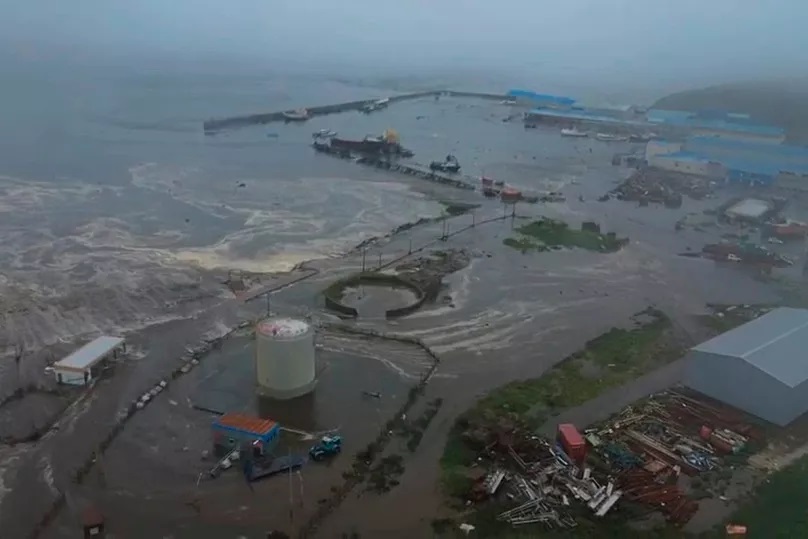
PETROPAVLOVSK-KAMCHATSKY, RUSSIA – July 30, 2025 – A colossal earthquake, registering a magnitude of 8.8, struck off Russia’s remote Kamchatka Peninsula today, unleashing a powerful tsunami that has sent alerts and waves across the Pacific Ocean, reaching as far as Japan, Hawaii, and the US West Coast. The tremor, one of the strongest recorded in decades, has caused significant concern and prompted immediate evacuations in vulnerable coastal areas.
The United States Geological Survey (USGS) initially reported the earthquake at a magnitude of 8.0, later revising it upwards to a staggering 8.8. The shallow quake, with a depth reported at approximately 19.3 kilometers (12 miles), hit roughly 125 kilometers (80 miles) east-southeast of Petropavlovsk-Kamchatsky, the largest city on the peninsula.
Local Russian authorities reported tsunami waves reaching up to 4 meters (13 feet) in parts of Kamchatka and the Northern Kuril Islands, leading to localized flooding and damage to buildings. While there are initial reports of some injuries sustained during the earthquake, including individuals hurt while evacuating or jumping from windows, no fatalities have been reported so far. Kamchatka Governor Vladimir Solodov confirmed damage to a kindergarten building and described the event as “the most powerful quake since 1952.”
The sheer force of the earthquake triggered immediate tsunami warnings and advisories across a vast swathe of the Pacific. Japan’s Meteorological Agency issued a tsunami advisory, with initial waves of up to 30 centimeters (one foot) observed in northern Japan, notably in Hokkaido. Concerns remain for subsequent, potentially larger waves, and residents have been urged to stay away from coastal areas.
Across the Pacific, Hawaii was placed under a tsunami warning, prompting sirens to blare and residents to seek higher ground. While initial waves were reported at around 1.2 meters (4 feet) in some Hawaiian locations, the warning was later downgraded to an advisory, allowing many previously evacuated residents to return. The US National Weather Service also issued a tsunami advisory for sections of the US West Coast, including parts of California, Oregon, and Washington, with expected wave heights of 1 to 2 feet. Countries including Ecuador, Colombia, Peru, and
French Polynesia also issued warnings and advisories, with French Polynesia bracing for waves up to 4 meters.
Seismologists from around the world have noted the significance of this event. Experts highlighted that the earthquake occurred along the Kuril-Kamchatka subduction zone, where the Pacific plate is actively being pushed beneath the North American plate. This region is part of the infamous Pacific “Ring of Fire,” a hotbed of seismic and volcanic activity. The current event is believed to be a major rupture in this subduction zone, similar in tectonic scenario to the devastating 2011 Tohoku earthquake in Japan. Scientists also indicated that recent smaller earthquakes in the area could now be considered “foreshocks” to today’s massive tremor.
Aftershocks, some potentially significant with magnitudes up to 7.5, are expected to continue in the region for at least the next month, maintaining a heightened state of alert for residents and emergency services. The widespread impact of this earthquake underscores the critical importance of robust early warning systems and disaster preparedness across the Pacific Rim.