
When the Music Stopped: The Shattered Peace and Silent Grief of Sunsari
If you walked through the narrow lanes of Ward 3 in Dewanganj a week ago, you would have heard the familiar sounds of a Terai summer: the hum of irrigation pumps, children shouting over games of cricket, and the rhythmic clatter of tea shop saucers.

Today, those lanes carry an eerie, heavy silence—broken only by the low rumble of Nepal Army armored vehicles rolling over crushed gravel.
In Kaptanganj, doors are bolted tight. Curtain edges twitch as strangers walk past, but nobody comes out to talk. On the night of July 26, 2026, a petty argument over a flag and a DJ sound system tore this close-knit community open at the seams, leaving 24-year-old Om Prakash Mehta dead from a police bullet and dozens more nursing physical and emotional wounds.
How does a neighborhood where people have shared meals, wedding feasts, and harvest seasons for generations collapse into chaos in less than three hours?
The answer isn’t simple, but if you trace the footsteps of that fateful night, a tragic pattern of modern provocations, systemic police failures, and broken trust comes into sharp, brutal focus.
The Spark: A Pole, a Flag, and a Speaker
It began quietly enough under the midday heat. Someone climbed a concrete utility pole and replaced a religious flag. In the Madhesh, where public space has increasingly become a battleground for symbolic influence, the gesture didn’t go unnoticed. Muffled grievances circulated through local group chats, but the afternoon passed without incident.
The real tipping point came at around 10:30 PM.
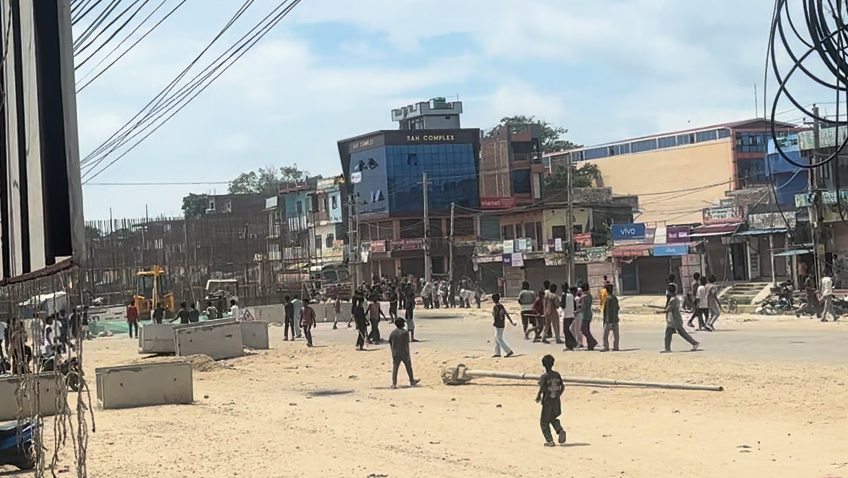
A local procession—led by a tractor carrying a massive wall of sound, pulsing heavy bass through high-decibel DJ speakers—stalled near a temple in Kaptanganj. In narrow rural streets, that level of volume isn’t just music; it’s an acoustic assault. Arguments broke out between groups of young men on the roadside.
“It started with shouting over the noise,” says a local merchant who watched from his second-story window, asking not to be named out of fear of police retaliation. “Then came the insults. Within fifteen minutes, boys who grew up in the same ward were throwing bricks at each other. You could hear the bamboo sticks cracking on the pavement.”
When the first patrol car from the Kaptanganj Police Post arrived, the officers were completely outmatched. Four officers armed with standard wooden batons stood between two surging, furious mobs of hundreds of young men.
Instead of calming the crowd, the presence of an under-resourced police force seemed to inflame it. Stones rained down. A police inspector was struck in the head, his blood pooling on the asphalt. Panic set in among the ranks.
By the time Armed Police Force (APF) reinforcements arrived, the air was thick with the acrid stench of tear gas. But the canisters—many of them outdated—did little to disperse the angry crowd. Cornered against a wall of brick houses, officers made a choice that turned a local riot into a human tragedy: they switched from tear gas to live ammunition.
“They didn’t shoot at the ground or into the air,” claims a relative of one of the wounded, currently receiving treatment in Biratnagar. “They fired straight into the dark. Om Prakash was standing near a corner when the bullet caught him. He wasn’t even throwing stones—he just came out to see what the noise was.”
Mehta collapsed on the dirt road. By the time neighbors managed to haul his limp body away from the crossfire, his pulse had stopped.
The Aftermath: Curfews and Empty Promises
By dawn, the government had done what it always does when local intelligence fails: it locked everything down. An indefinite curfew was clamped across five major market hubs, and armed soldiers were deployed to enforce a uneasy quiet.
In the Mehta household, the grief is suffocating. Om Prakash was a young man with his whole life ahead of him—the primary breadwinner for an extended family that now faces an uncertain future.
While district officials issue routine statements promising “investigative committees” and “compensation,” locals have heard it all before. The tragic reality is that Sunsari is not an isolated case. Across the southern plains—from Birgunj to Sarlahi—the script remains identical:
-
Petty micro-provocations (flags, high-volume speakers, viral social media clips) are allowed to fester unchecked.
-
Local administration ignores early warning signs, failing to set ground rules before gatherings start.
-
Frontline police lack proper crowd-control gear, leaving them terrified and relying on lethal force when things go wrong.
The Hard Questions Left Unanswered
As the dust settles over Kaptanganj, the physical scars will eventually heal, and the curfews will be lifted. But the deeper damage remains.
Why were high-decibel DJ systems permitted late at night during a known period of local tension? Why did frontline police officers lack basic non-lethal equipment like modern water cannons or rubber bullets? And why must a young man lose his life before the state recognizes that community harmony cannot be enforced with loaded rifles?
Until the government addresses the root causes—regulating aggressive public displays, training police in genuine de-escalation, and empowering local elders to mediate petty disputes—the peace in Sunsari will remain fragile, built on a foundation of curfew orders, armed patrols, and silent grief.


