The Future of Food : How IoT and AI can Transform Nepal’s Agriculture

Atul Upadhyay, PhD, MBA

President – Nepal Food Scientists and Technologists Association
Chairperson – Vertex Special Technology
In Nepal, where agriculture contributes to about 27% of the GDP and employs a majority of the population, the challenges of food loss and traceability are not just logistical or economic issues; they are urgent social and scientific concerns. These challenges also directly impact Nepal’s progress toward achieving Sustainable Development Goal 2 (SDG 2) – ending hunger and promoting sustainable agriculture. While the Internet of Things (IoT) and Artificial Intelligence (AI) offer promising solutions deeply rooted in the principles of food science, it’s crucial to acknowledge the complexities and challenges involved. This article aims to explore how IoT, complemented by AI, can revolutionize Nepal’s food supply chain from a food science perspective, address local challenges, deliver significant economic benefits, and contribute to the achievement of SDG 2, all while considering the practical challenges and solutions.

General Measures through IoT
IoT can be used to preserve food through real-time monitoring. Temperature plays a crucial role in microbial growth rates. IoT sensors can monitor temperature in real-time, allowing us to understand and control the microbial ecology of stored food, thereby extending its shelf life. Similarly, optimal humidity is essential to maintain food quality. Since different foods have different water activity requirements, IoT humidity sensors can help maintain the optimal water activity levels, preserving the texture and quality of food. Thus, using sensors to monitor temperature and humidity in food storage facilities can help to prevent food spoilage and ensure that food is stored at the correct temperature, thereby extending its shelf life.
While IoT excels at collecting real-time data essential for monitoring food quality, Artificial Intelligence (AI) can take this a step further. Leveraging principles of food science, AI algorithms can analyze the complex data sets generated by IoT to predict spoilage rates, optimize storage conditions, and even recommend adjustments in food processing techniques. This symbiotic relationship between IoT and AI not only enhances the efficiency of the food supply chain but also opens new avenues for food science research and innovation.
Smart Inventory Management
Smart inventory management is yet another potential application of IoT in the food industry. The principle of using older stock before newer stock is rooted in food chemistry. AI can further optimize this by predicting which items are likely to spoil first, allowing for even more efficient stock rotation. As food ages, chemical reactions like oxidation can degrade its quality. IoT can automate the First-In, First-Out (FIFO) strategy, ensuring that food is consumed in a state that retains most of its nutritional value. Moreover, certain foods are prone to enzymatic browning or spoilage. IoT, combined with AI and predictive analysis, can forecast these changes, allowing for timely interventions like adding preservatives or adjusting storage conditions.
Traceability and Food Safety
Perhaps one of the most important uses of IoT in Nepal is for maintaining traceability and food safety. IoT can help in identifying the source of foodborne pathogens more quickly than traditional methods, which is crucial for public health. IoT devices can also track and record the nutritional content of food as it moves through the supply chain, providing consumers with more accurate information. Additionally, by integrating biochemical data into a blockchain, we can create an immutable record of a food item’s nutritional and safety profile, from farm to table.
Addressing Local Challenges in Nepal
Lack of Cold Storage Facilities: One of the most pressing challenges in Nepal is the lack of cold storage facilities. According to a study by the Food and Agriculture Organization (FAO), approximately 20-25% of fruits and vegetables produced in Nepal are lost due to inadequate storage. IoT could be a game-changer here. AI can help optimize the use of available cold storage space by analyzing various factors like temperature, humidity, and the type of food being stored. Sensors can monitor the temperature of food in transit and alert farmers and distributors if the temperature rises above safe levels, thereby preventing spoilage and reducing post-harvest losses.
Unreliable Electricity: Nepal faces frequent power outages, with rural areas experiencing up to 14 hours of load-shedding per day according to the Nepal Electricity Authority. This makes it difficult to maintain the cold chain for perishable goods. IoT can help develop solar-powered cold storage solutions that are not dependent on the grid. These solutions would be more affordable and sustainable, ensuring that food remains fresh even during power outages.
Challenging Terrain: Nepal’s mountainous terrain makes transportation a logistical nightmare. According to the World Bank, only about 65% of the rural population has access to all-weather roads. IoT can help here by tracking vehicles in real-time and providing alerts if there are delays or disruptions due to weather or road conditions. This can ensure that food reaches its destination in the best possible condition, reducing the risk of spoilage and waste.
Economic Benefits of IoT and AI in the Food Supply Chain
As mentioned earlier, approximately 20-25% of fruits and vegetables are lost due to inadequate storage in Nepal. By reducing this loss through IoT monitoring, farmers and distributors can significantly increase their revenue. Even a 10% reduction in food loss can translate into millions of dollars in additional revenue annually. IoT can automate various aspects of the food supply chain, from inventory management to temperature control. This automation can significantly reduce labor costs and improve efficiency. Real-time tracking and traceability can open doors to markets that have stringent food safety and quality requirements. AI can analyze market trends and consumer preferences, helping producers target the right markets for their products.
IoT can also enable new business models such as subscription-based monitoring services for farmers or pay-as-you-go cold storage solutions. The adoption of IoT will necessitate skilled labor which can lead to job creation, particularly in rural areas. Finally, a technologically advanced and efficient food supply chain can attract both domestic and foreign investment.
Aligning with Sustainable Development Goals (SDG 2)
The integration of IoT into Nepal’s food supply chain is not just a technological advancement; it’s a step toward achieving Sustainable Development Goal 2 (SDG 2) – to end hunger, achieve food security, and promote sustainable agriculture. By reducing food loss through real-time monitoring and enhancing food safety through traceability, we are directly contributing to improved food security. Moreover, the economic benefits, such as reduced operational costs and increased revenue, can empower farmers and other stakeholders, thereby promoting sustainable agriculture. In this way, IoT serves as a tool that can help Nepal make significant strides in achieving SDG 2.
Global Examples of IoT and AI in the Food Industry
Several multinational companies have been successfully using IoT in the food industry. For example, Walmart has collaborated with IBM for blockchain technology to effectively trace a contaminated batch of lettuce back to its source within seconds. Maersk also collaborated with IBM in using blockchain technology to ensure that seafood is sustainably sourced and stored under optimal conditions. Dole Food Company uses IoT sensors to monitor conditions of its products during transit, providing unprecedented transparency. Tyson Foods and FoodLogiQ’s IoT sensors track the condition and location of food products from farm to retail, ensuring quality and safety. Lineage Logistics has IoT-enabled smart refrigeration that significantly reduce energy cost and food spoilage.
Similarly, several other companies also use AI for various reasons. General Electric uses AI algorithm for predictive maintenance reducing the downtime in food processing plants, thereby preventing food spoilage. Siemens employs AI to predict machinery failure in food processing, allowing for timely maintenance and operational efficiency. TOMRA utilizes AI-powered optical sorting that ensures high-quality produce reaches the market while reducing food waste. Blue River Company uses AI to analyze visual data of crops, allowing for more precise application of fertilizers and pesticides, which leads to increased yields and sustainability.
Challenges and Food Science Solutions
While the advantages of incorporating IoT into Nepal’s food logistics are significant, it’s vital to recognize the inherent challenges and intricacies. First, the extensive data produced by IoT devices demands specialized skills for insightful analysis. Food scientists can fill this void by crafting algorithms that factor in elements like pH balance and microbial activity, facilitating immediate decisions on food quality and safety. Second, the upfront costs of IoT technology can be a barrier for small-scale farmers, making it essential to create budget-friendly sensors and explore government financial support. Third, the precision of sensor calibration is crucial; food scientists can create uniform guidelines based on the unique properties of different foods to guarantee reliable data. Lastly, the growing volume of data collection heightens the risk of security breaches, necessitating stringent cybersecurity protocols. Additionally, while AI offers valuable support in data interpretation, it brings its own set of challenges, including data security and ethical dilemmas. By actively tackling these issues, we set the stage for a more efficient and ethical application of IoT in Nepal’s food supply chain.
Conclusion
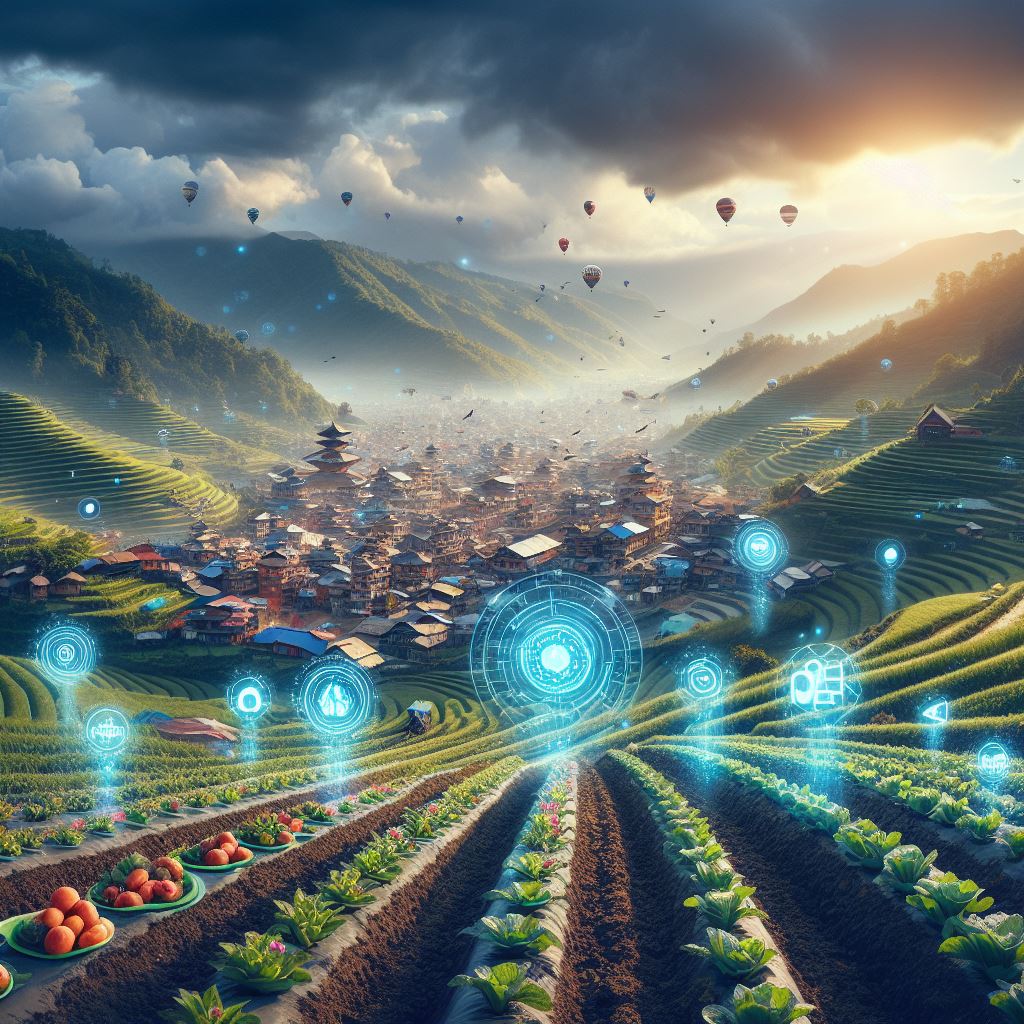
The integration of IoT – and to some extent, AI – into Nepal’s food supply chain presents an unprecedented opportunity to address a host of challenges, from extending the shelf life of perishable goods to opening up new markets through enhanced traceability. However, the journey is not without its hurdles. Issues ranging from data interpretation to cost-effectiveness and data security need to be carefully navigated. Fortunately, food science offers a wealth of solutions to these challenges, from developing low-cost sensors to creating secure data storage protocols. Beyond these operational and scientific advantages lie significant economic benefits and alignment with global sustainability goals, specifically Sustainable Development Goal 2. The synergistic application of IoT and AI not only promises a technological revolution but also opens new avenues for food science research and innovation. Imagine a Nepal where farmers in Terai can get real-time data on soil moisture, or where consumers in Kathmandu can trace the origins of their organic vegetables. Similarly, in neighboring India, IoT is already being used to monitor the cold chain for dairy products, ensuring that millions receive fresh milk daily. This is not just a technological revolution; it’s a multi-faceted transformation that encompasses food science, logistics, economics, and sustainable development. By embracing IoT and AI, we’re not just adopting new technology; we’re paving the way for a safer, more efficient, and more prosperous food supply chain in Nepal, contributing to the global effort to achieve SDG 2