Shah’s Delhi trip joins a long cycle of resets: every PM-level visit between Nepal and India since the republic
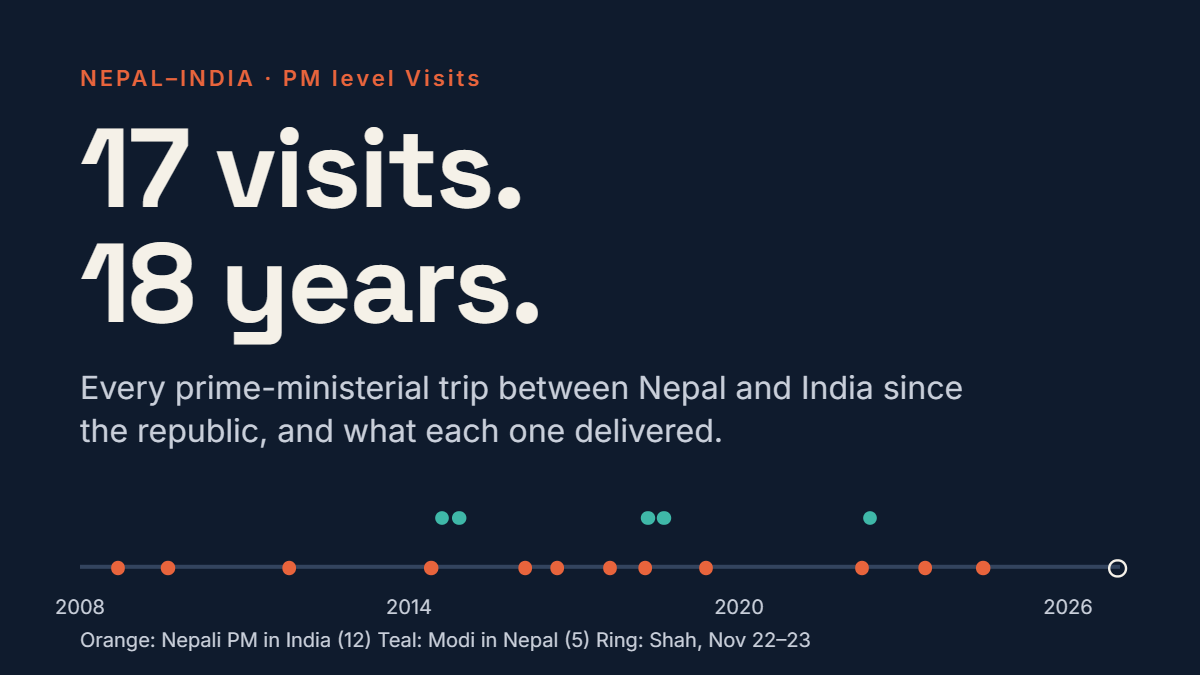
Prime Minister Balendra Shah flies to New Delhi on Sunday for a two-day visit, the latest in a run of prime-ministerial trips between Nepal and India that began when the monarchy ended in 2008. In the 18 years since, Nepali prime ministers have made at least 12 visits to India, while Indian prime ministers have come to Nepal on five occasions, all of them Narendra Modi.

A review of those visits shows a consistent pattern: leaders return with deals on trains, power and roads, while the 1950 treaty, the border disputes and the Pancheshwar project keep being referred to officials and keep stalling.
Shah, 36, took office on March 27 after his Rastriya Swatantra Party won the first election since the September 2025 youth-led protests. It is his first official bilateral trip abroad. He is due to call on President Droupadi Murmu on Sunday, with talks with Modi on Monday, November 23. Nepal is seeking more than US$2 billion in Indian help for reconstruction after the August 26 Bhotekoshi disaster, plus more air routes through Indian airspace and movement on Pancheshwar.
Nepali Prime Ministers in India
September 14–18, 2008 — Pushpa Kamal Dahal “Prachanda.” The first visit of the republic era came after Prachanda went to China first, breaking the custom of making India the first stop. The talks proposed a mechanism to review the 1950 treaty, and India announced IRs 200 million in flood relief.
August 2009 — Madhav Kumar Nepal. An official visit that secured access to Visakhapatnam port and an understanding on a revised 1996 trade treaty.
October 2011 — Baburam Bhattarai. An official visit that produced the investment protection agreement (BIPPA) and agreement in principle on the Eminent Persons’ Group (EPG) to review bilateral treaties.
May 26, 2014 — Sushil Koirala. Koirala attended Modi’s first swearing-in and pressed for help with roads and flood control. Modi promised assistance once Nepal presented concrete plans.
February 2016 — KP Sharma Oli. Oli travelled after India’s 2015 blockade, which followed Nepal’s new constitution. The visit restored relations but the two sides could not agree on wording about the constitution, so no joint communiqué was issued.
September 15–18, 2016 — Prachanda. A state visit focused on carrying out earlier agreements and seeking Indian backing for the constitution, which India did not give.
From August 23, 2017 — Sher Bahadur Deuba. A five-day state visit. The two sides ordered the Pancheshwar project report completed within a month.
April 2018 — Oli. Oli came with a strong electoral mandate and spoke of relations on an equal footing. The visit produced understandings on a Raxaul–Kathmandu railway and inland waterways.
May 30–31, 2019 — Oli. Oli attended Modi’s second swearing-in, with bilateral talks on the sidelines.
April 1–3, 2022 — Deuba. An official visit to Delhi and Varanasi, during which the Jayanagar–Kurtha passenger train was flagged off. There was no joint statement.
May 31–June 3, 2023 — Prachanda. His first foreign trip after taking office in December 2022. India announced plans to buy 10,000 MW of Nepali power over ten years and opened an export route to Bangladesh.
June 9–10, 2024 — Prachanda. He attended Modi’s third swearing-in.
Indian prime ministers in Nepal
After Inder Kumar Gujral’s 1997 trip, no Indian prime minister made a bilateral visit to Nepal until Modi came in 2014, a gap of 17 years.
August 3–4, 2014. An official visit. Modi prayed at Pashupatinath, but planned stops at Janakpur, Lumbini and Muktinath did not happen.
November 25–27, 2014. He returned for the 18th SAARC summit in Kathmandu. Several agreements were signed, and the Lumbini trip was dropped again.
May 11–12, 2018. A pilgrimage-style visit to Janakpur, where Oli received him, then Muktinath and Pashupatinath. A Janakpur–Ayodhya bus service was launched.
August 30–31, 2018. He came for the BIMSTEC summit in Kathmandu. The Lumbini visit he had promised in May was not made.
May 16, 2022. At Deuba’s invitation, Modi became the first Indian prime minister to visit Lumbini, on Buddha Purnima. He stayed about six hours and did not go on to Kathmandu.
Nepali press reports say Modi has not returned despite repeated invitations since 2022.
The trips that did not happen
The “India first” custom has never been a rule. Prachanda in 2008 and Oli in 2024 both chose China first. Jhalanath Khanal (2011) and interim government head Khil Raj Regmi (2013) left office without a Delhi trip. Koirala made the 2014 swearing-in trip but received no official bilateral invitation.
Oli’s third term ended without a visit. India’s foreign secretary handed him an invitation in August 2025 and a September 16–17 trip was planned, but Oli resigned on September 9 amid the protests, becoming the first Nepali prime minister not to visit India during a term. Interim Prime Minister Sushila Karki spoke to Modi by phone on September 18, 2025; no in-person visit during her tenure turned up in my research.
What the record suggests
- Visits follow political resets. Oli’s 2016 trip came after the blockade, while the 2014, 2019 and 2024 trips were swearing-in occasions rather than negotiations.
- Connectivity and energy deliver; sovereignty issues do not. Trains, buses, power trade and waterways produce agreements. The 1950 treaty, the Kalapani, Limpiyadhura and Susta disputes and Pancheshwar are repeatedly referred to officials.
- The EPG report is still parked. The Eminent Persons’ Group finished its report in July 2018, and India has not formally received it.