
The Cost of Inaction: Nepal’s Stalled Space Ambitions, Scientific Underfunding, and Total Satellite Dependency
While small teams of passionate Nepali engineers and students have demonstrated technological ingenuity by building and launching low-Earth-orbit nanosatellites, Nepal’s national space strategy remains trapped in bureaucratic inertia. Despite holding internationally recognized geostationary orbital slots for more than four decades, Nepal possesses no operational sovereign satellite fleet. Instead, the nation relies entirely on foreign satellite constellations for broadcasting, disaster forecasting, civil aviation, and rural connectivity—a structural vulnerability that drains billions of rupees annually in foreign exchange.

The Tale of Two Space Programs: Grassroots Triumphs vs. Strategic Paralysis
Nepal’s engagement with space technology presents a sharp contrast between bottom-up grassroots innovation and top-down institutional stagnation.
The Grassroots Milestones
-
NepaliSat-1 (2019): Developed by Nepali engineers Abhas Maskey and Hariram Shrestha under the BIRDS-3 project at Japan’s Kyushu Institute of Technology, this 1U CubeSat (~1.3 kg) became Nepal’s maiden satellite, collecting environmental and geographic data from low-Earth orbit until late 2021.
-
Sanosat-1 (2022): Built by private aerospace startup Orion Space, this 5×5×5 cm PocketQube was placed into orbit aboard a SpaceX Falcon 9 rocket to test amateur radio telemetry and radiation monitoring.
-
Student Initiatives (Munal & Slippers2Sat): Grassroots non-profits like Antarikchhya Pratishan Nepal (APN) have engaged high school and indigenous students to assemble educational CubeSats designed for Earth observation and vegetation mapping.
Grassroots Space Efforts
- NepaliSat-1, Sanosat-1, Munal
- Built by students & young engineers
- Low-Earth Orbit (CubeSats/PocketQubes)
- Modest budgets, high initiative
National Strategic Space
- No dedicated Space Agency
- Failed satellite procurement tenders
- 40+ years of unused ITU orbital slots
- Complete reliance on foreign leases
The Strategic Gridlock
In stark contrast to these student-led achievements, the state has repeatedly failed to execute a sovereign telecommunications satellite project:
-
Four Decades of Dormant Orbital Slots: In 1984, the International Telecommunication Union (ITU) allocated two prime geostationary orbital slots to Nepal—50°E and 123.3°E. For over 40 years, Nepal has failed to deploy a satellite to occupy either slot, repeatedly risking revocation.
-
Aborted Procurement Tenders: Between 2016 and 2022, the Nepal Telecommunications Authority (NTA) launched and subsequently canceled multiple international tenders for satellite procurement, spectrum leasing, and consultancy due to procedural disputes, policy ambiguity, and procurement controversies.
-
Institutional Fragmentation: Unlike neighboring space agencies such as India’s ISRO or Pakistan’s SUPARCO, Nepal lacks a unified national space agency. Space affairs are scattered across the Ministry of Communication and Information Technology (MoCIT), NTA, the Ministry of Education, Science and Technology (MoEST), and the Nepal Academy of Science and Technology (NAST).
NAST and the Budget Paradox: Four Decades of Scientific Spending
At the center of domestic scientific development stands the Nepal Academy of Science and Technology (NAST), established on December 5, 1982 (initially as RONAST) under the ex-officio chairmanship of the Prime Minister.
Typical NAST Annual Budget Allocation (~NPR 350M – 450M)
- Recurrent / Administrative / Mandatory (~65% – 75%)
- Research/Cap (~25-35%)
Historical Budget & Expenditure Trends
-
Cumulative Public Investment (1982–2022): Over its first 40 years of operation, NAST received a cumulative total of approximately NPR 3.97 billion from the government treasury.
-
Current Allocations: Annual government budgetary support hovers between NPR 330 million and NPR 450 million.
-
Administrative Overhead: Audits by the Office of the Auditor General (OAG) reveal that 65% to 75% of NAST’s annual budget is absorbed by recurrent administrative costs—salaries, facility upkeep, and overhead—leaving minimal capital for high-impact laboratory experiments or advanced aerospace R&D.
-
Underutilization and Vacancies: Significant portions of research and machinery budgets frequently go unspent and lapse back to the national treasury due to procurement bottlenecks, regulatory friction, and persistent vacancies in permanent research positions.
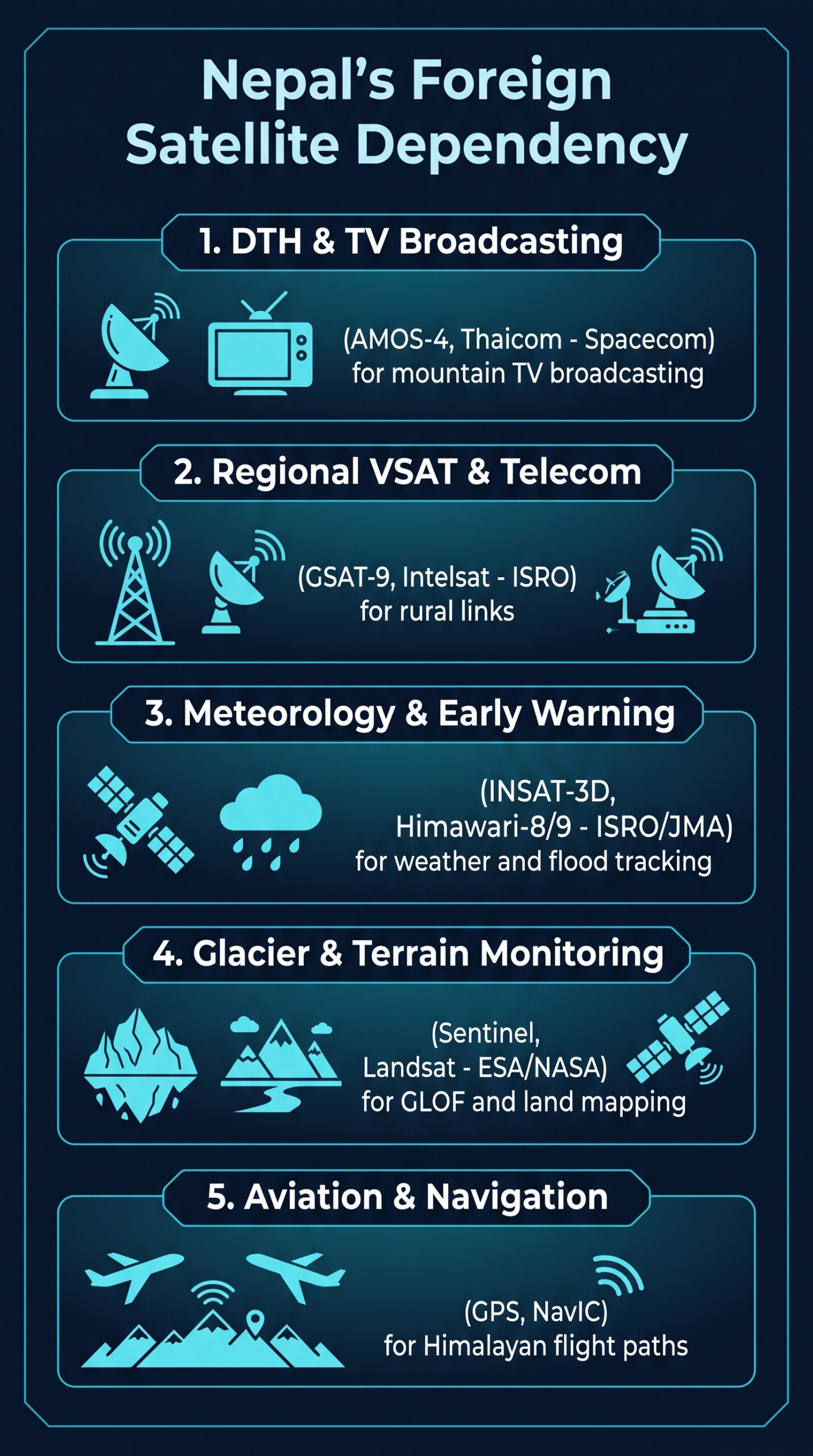
The Anatomy of Total Dependency
Without a national satellite, Nepal depends entirely on foreign public and commercial satellite constellations across all critical sectors:
The Vulnerability: What Happens If Services Are Interrupted?
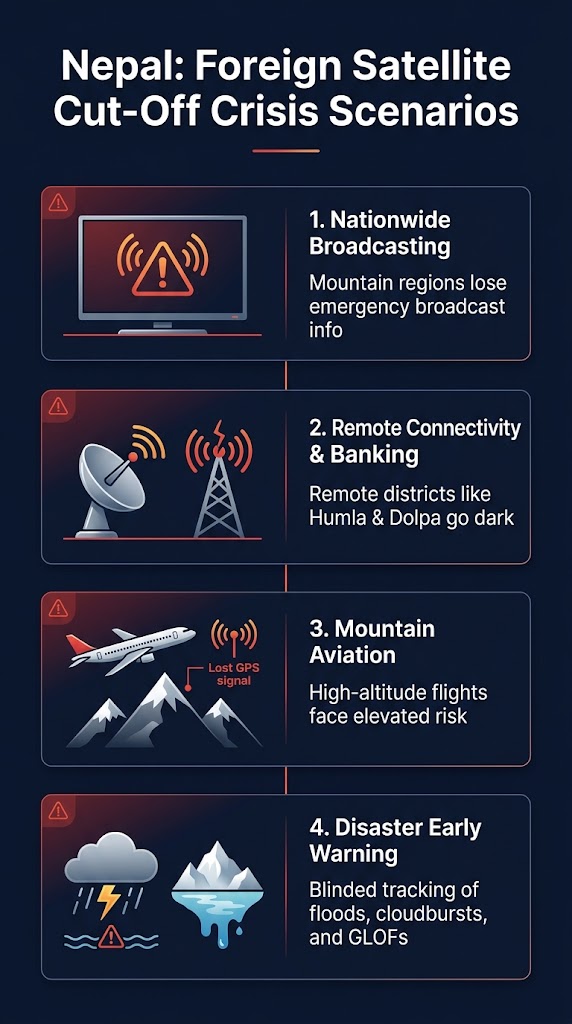
Nepal’s reliance on third-party satellite links exposes the nation to immediate disruptions if access is degraded or severed:
The Economic Imbalance: National Leases vs. Scientific Investment
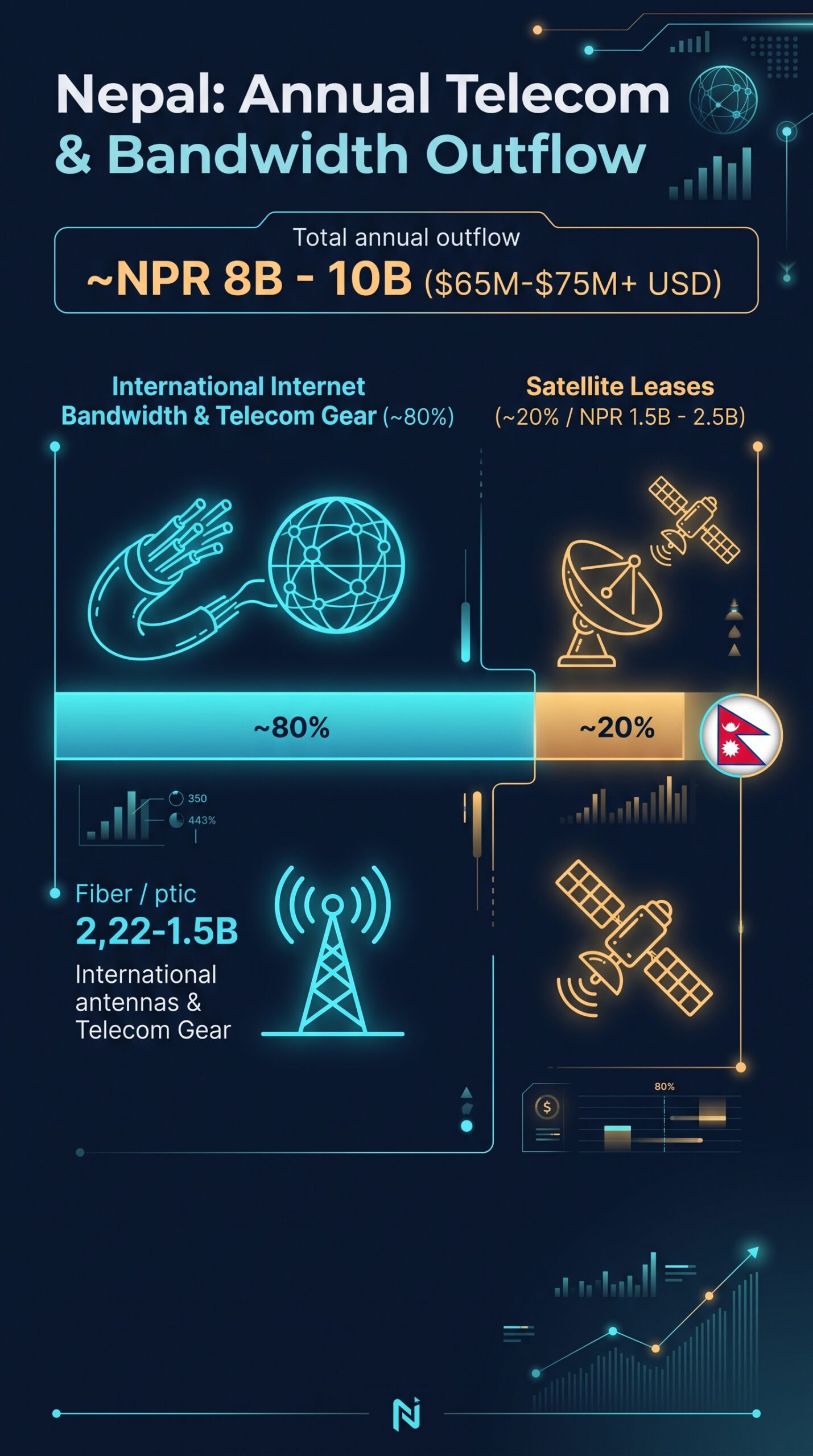
The economic cost of satellite inaction represents a chronic foreign currency drain:
-
Foreign Exchange Outflow: Private DTH broadcasters and telecommunications entities in Nepal remit an estimated NPR 1.5 billion to NPR 2.5 billion annually to foreign operators solely for satellite transponder capacity and leasing fees.
-
The 2-Year Disparity: In just two years, the foreign currency sent abroad to rent foreign satellite bandwidth exceeds the entire 40-year cumulative budget allocated to NAST (NPR ~4 billion between 1982 and 2022).
-
Total Telecom Imports: When combined with international cross-border fiber bandwidth from India and China, Nepal’s telecom sector transfers NPR 8 billion to NPR 10+ billion per year out of its foreign exchange reserves
To escape this cycle of external dependency and capital drain, Nepal must implement a targeted roadmap:
-
Establish a Dedicated Space Commission: Consolidate fragmented responsibilities from NAST, NTA, MoCIT, and MoEST under a unified National Space Agency to lead long-term policy.
-
Secure and Monetize Orbital Slots: Pursue public-private partnerships (PPP) or international joint ventures to build or co-locate a satellite in Nepal’s ITU slots before orbital rights are lost.
-
Reallocate Scientific Budgets: Restructure NAST’s budget formula from an administrative-heavy model to a competitive, project-based grant model that funds functional laboratories, cleanrooms, and testing facilities.
-
Scale University-Industry Pipelines: Institutionalize funding for initiatives pioneered by groups like APN and Orion Space, transforming student CubeSat demonstrations into commercially viable remote-sensing and data-relay networks.