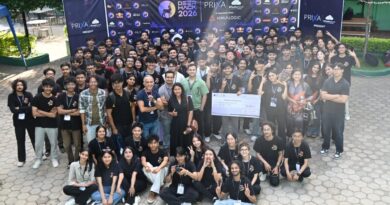
Nepal Reaches for the Stars: Student-Built ‘MUNAL’ Satellite Successfully Launched
KATHMANDU — In a historic leap for Nepal’s burgeoning space sector, the MUNAL satellite, the first-ever spacecraft built by Nepali high school students, was successfully launched into orbit today, January 12, 2026. The launch took place at 10:32 AM NST from the Satish Dhawan Space Centre in Sriharikota, India, aboard ISRO’s Polar Satellite Launch Vehicle (PSLV-C62).

This achievement marks Nepal’s second entry into space, following the 2019 launch of NepaliSat-1, but it represents a significant shift toward indigenous development and youth-led innovation.
A Project Born in the Classroom
The MUNAL project is the result of a two-year journey that began in January 2022. It was spearheaded by a core team of nine high school students from the Munal High School Consortium, which includes:
-
Kathmandu University High School (KUHS)
-
Chaitanya Secondary School
-
Azad Secondary School
-
Sanjiwani Model Higher Secondary School
Under the mentorship of Antarikchya Pratisthan Nepal (APN) and the Nepal Academy of Science and Technology (NAST), these students designed, assembled, and tested the 1U CubeSat (a 10cm cube weighing approximately 1.1 kg) entirely within the Space Systems Laboratory at KUHS.
Mission Objectives and Technical Prowess
Unlike its predecessor, MUNAL is equipped with more advanced “Made-in-Nepal” technology. Its primary missions include:
-
Vegetation Monitoring: Using dual RGB and Near-Infrared (NIR) cameras to build a database of vegetation density across the Earth’s surface.
-
AI-Driven Data Processing: For the first time, a Nepali satellite will utilize Artificial Intelligence (Image Segmentation) to identify landmasses in real-time. This allows the satellite to filter out “cloudy” or “useless” images before downlinking, significantly increasing data efficiency.
-
Indigenous Technology Testing: The mission will flight-test a novel Satellite System-on-Chip (SSoC) for communication and data handling, designed domestically by APN and the students.
-
Art in Orbit: Carrying a symbolic “Art Mission” to promote Nepali culture in the global space community.
Diplomatic and Regional Significance
The launch was made possible through a strategic partnership between Nepal and India. The Indian Space Research Organisation (ISRO) provided the launch service through its commercial arm, NewSpace India Limited (NSIL), under a grant assistance agreement signed in late 2024.
Dr. Rabindra Prasad Dhakal, Member Secretary of NAST, stated from the ground station in Khumaltar, Lalitpur:
“This isn’t just about a satellite; it’s about proving that our youth can handle the complexities of space science. MUNAL is a beacon of hope for Nepal’s ‘Vision 2050’, which aims to establish a self-reliant space industry.”
What’s Next?
The satellite is currently positioned in a Low Earth Orbit (LEO) at an altitude of approximately 500–600 km. The student team at the Khumaltar ground station expects to receive the first “beacon” signals within the next few hours. Once operational, MUNAL is expected to remain in orbit for at least six months, providing critical environmental data that could help Nepal track deforestation and glacial melt in the Himalayas.