Elon Musk announces the launch of the “America Party
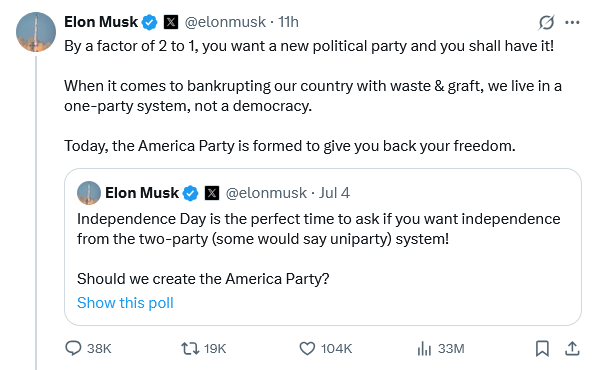
On July 5, 2025, tech mogul Elon Musk announced the formation of the “America Party,” presenting it as a fresh political entity designed to combat what he calls America’s “one-party state.” This move follows a period of increasing tension between Musk and President Donald Trump, specifically over a large spending bill that Musk criticized as financially irresponsible.

Musk used X, the social media platform he owns, to introduce the party, characterizing it as a response to perceived corruption, mismanagement, and a political establishment that prioritizes consultants over voters. A dedicated website for the party was immediately launched, and within hours, its social media accounts garnered tens of thousands of followers, instantly sparking political debate.
The Genesis of the “America Party”
Elon Musk’s decision to establish a new political party was not spontaneous. It emerged from a significant public rift with President Trump, who had previously appointed Musk as a key economic advisor during his current second term.
The friction intensified after Congress approved Trump’s “One Big Beautiful Bill,” a comprehensive federal spending package that Musk strongly opposed. He argued that the legislation betrayed conservative fiscal principles, accusing lawmakers of hypocrisy for authorizing substantial expenditures while advocating for restraint.
The bill’s passage served as the ultimate catalyst for Musk. He felt that Republican leaders had abandoned their commitment to limited government and free-market policies, leaving voters without a genuine alternative. Seizing on public dissatisfaction, Musk also conducted polls on X, where over 65% of millions of users supported the idea of a third party, which he interpreted as a mandate.
Musk has portrayed the America Party as a grassroots movement grounded in “common sense,” distinguishing it from both established party machines. His rhetoric suggests frustration not only with Democrats but also with a Republican Party he believes has lost its core identity. The announcement’s timing, post-Independence Day, was symbolic of a break from traditional political norms.
Core Principles of the America Party (According to Musk)
While a formal policy platform for the America Party is still pending, its initial messaging aligns with Elon Musk’s broader philosophy: fiscal prudence, deregulation, and a strong critique of entrenched political interests. The America Party appears to position itself not merely as centrist or moderate, but as a direct challenge to systemic dysfunction. Musk has consistently criticized both Democrats and Republicans for enabling corporate welfare, government overreach, and an erosion of civil liberties. His statements also suggest a desire to decentralize power from traditional institutions in favor of more technology-driven governance.
The party’s specific stances on issues like immigration, healthcare, or climate change remain undefined. However, Musk is banking on public frustration and weariness with both major parties. The party is likely to attract disaffected conservatives, libertarians, and younger voters who are skeptical of establishment politics, a demographic Musk believes is politically untapped.
Here’s a rephrased version of the article about Elon Musk’s “America Party”:
Elon Musk Launches “America Party” to Challenge Perceived “One-Party State”
On July 5, 2025, tech mogul Elon Musk announced the formation of the “America Party,” presenting it as a fresh political entity designed to combat what he calls America’s “one-party state.” This move follows a period of increasing tension between Musk and President Donald Trump, specifically over a large spending bill that Musk criticized as financially irresponsible.
Musk used X, the social media platform he owns, to introduce the party, characterizing it as a response to perceived corruption, mismanagement, and a political establishment that prioritizes consultants over voters. A dedicated website for the party was immediately launched, and within hours, its social media accounts garnered tens of thousands of followers, instantly sparking political debate.
The Genesis of the “America Party”
Elon Musk’s decision to establish a new political party was not spontaneous. It emerged from a significant public rift with President Trump, who had previously appointed Musk as a key economic advisor during his current second term.
The friction intensified after Congress approved Trump’s “One Big Beautiful Bill,” a comprehensive federal spending package that Musk strongly opposed. He argued that the legislation betrayed conservative fiscal principles, accusing lawmakers of hypocrisy for authorizing substantial expenditures while advocating for restraint.
The bill’s passage served as the ultimate catalyst for Musk. He felt that Republican leaders had abandoned their commitment to limited government and free-market policies, leaving voters without a genuine alternative. Seizing on public dissatisfaction, Musk also conducted polls on X, where over 65% of millions of users supported the idea of a third party, which he interpreted as a mandate.
Musk has portrayed the America Party as a grassroots movement grounded in “common sense,” distinguishing it from both established party machines. His rhetoric suggests frustration not only with Democrats but also with a Republican Party he believes has lost its core identity. The announcement’s timing, post-Independence Day, was symbolic of a break from traditional political norms.
Core Principles of the America Party (According to Musk)
While a formal policy platform for the America Party is still pending, its initial messaging aligns with Elon Musk’s broader philosophy: fiscal prudence, deregulation, and a strong critique of entrenched political interests. The America Party appears to position itself not merely as centrist or moderate, but as a direct challenge to systemic dysfunction. Musk has consistently criticized both Democrats and Republicans for enabling corporate welfare, government overreach, and an erosion of civil liberties. His statements also suggest a desire to decentralize power from traditional institutions in favor of more technology-driven governance.
The party’s specific stances on issues like immigration, healthcare, or climate change remain undefined. However, Musk is banking on public frustration and weariness with both major parties. The party is likely to attract disaffected conservatives, libertarians, and younger voters who are skeptical of establishment politics, a demographic Musk believes is politically untapped.
Trump’s Reaction to Musk’s Political Venture
Donald Trump has responded fiercely to Elon Musk’s political challenge. Once close allies, their relationship has devolved into open animosity since Musk publicly condemned Trump’s budget legislation. The President has retaliated with personal and political threats. On his social media platform, Truth Social, Trump ridiculed Musk’s citizenship, labeling him a South African “foreigner” who should be “sent home.”
He also suggested that federal investigators should review Musk’s businesses, including Tesla and SpaceX, both of which have historically received government contracts and subsidies. This veiled threat implied consequences for challenging Trump.
Trump’s associates, such as Steve Bannon, have gone further, accusing Musk of undermining national interests and disrespecting Trump’s “America First” agenda. Bannon even questioned the legality of a naturalized citizen founding a new political party. The animosity transcends mere policy disagreements.
Musk’s America Party directly threatens Trump’s political dominance, particularly with the 2026 midterms approaching. If Musk’s movement can draw enough Republican support, it could jeopardize the chances of Trump-backed candidates in crucial swing states. Their escalating feud has transformed into a full-blown political conflict with unpredictable outcomes.
Assessing the “America Party”: Serious Movement or Tech Mogul’s Stunt?
Critics dismiss Elon Musk’s new party as a self-serving project—another grand claim from a figure known more for disruption than detailed policy. They highlight the absence of formal structure, a defined platform, or leadership beyond Musk himself. However, others caution against underestimating its potential influence. They suggest that if Musk can apply his disruptive strategies to politics, the America Party could rapidly gain traction, especially among independent voters and younger demographics disillusioned with the status quo.
The party already boasts a functional website, rapidly increasing online engagement, and nascent fundraising efforts. Furthermore, Musk’s stated intention to focus on a limited number of winnable congressional districts suggests a strategic approach rather than mere showmanship.
Should the party succeed in influencing or flipping even a few seats, it could wield legislative power disproportionate to its size. While it’s premature to forecast electoral success, dismissing the America Party as insignificant overlooks Musk’s track record of transforming unconventional ideas into mainstream realities.
Potential Influence on the 2026 Midterm Elections
The America Party could significantly influence the 2026 midterm elections, which appears to be its primary objective. Elon Musk has indicated that the party will concentrate on a select number of House and Senate races in 2026, targeting districts with narrow margins where small shifts can alter outcomes. His strategy is not to build a national coalition overnight but to gain leverage in Washington by becoming the deciding factor on contentious legislation.
With Congress frequently closely divided, even a few independent members could reshape negotiations on taxation, budgets, and national policy. Musk understands this political dynamic and has already floated the idea of recruiting candidates for 8 to 10 House races and 2 to 3 Senate contests. These races would not necessitate a party majority, just strategically placed victories. This approach could also appeal to voters who feel their vote rarely matters in broader national elections but could sway a local swing district.
Early polling suggests increasing frustration with both major parties. If the America Party fields compelling candidates with local credibility, it could attract independents and even some moderate Republicans or Democrats. This is why political analysts are beginning to take Musk’s initiative seriously, despite its unconventional launch.
Legal and Logistical Challenges for the America Party
While forming a political party in the United States is conceptually straightforward, its execution is complex. The America Party has not yet publicly crossed this threshold, but that moment may be imminent. Without existing infrastructure or professional campaign staff, the America Party will need rapid organizational expansion.
It must also determine whether to run candidates directly under its banner or support independents who align with Musk’s objectives. Fundraising, messaging, and candidate recruitment will need to scale quickly if the party intends to contest the 2026 elections.
Musk possesses the financial resources to fund these endeavors, but money alone cannot substitute for grassroots political groundwork. The party must also navigate media scrutiny, opposition research, and potential legal challenges. In essence, while announcing a party is easy, transforming it into a ballot-ready, voter-facing force is a substantial undertaking, even for the world’s wealthiest individual.
Insights into Contemporary American Politics from Musk’s New Party
The emergence of the America Party vividly reflects growing public disillusionment with America’s traditional political order. Over 40% of voters now identify as independents, and trust in both major parties continues to decline. Musk is leveraging this sentiment, positioning himself as a disruptor of entrenched elites and political theatrics.
Musk’s portrayal of the “uniparty”—two parties that publicly feud but privately collude on spending and power—resonates with voters who feel ignored, overtaxed, and underrepresented. The immediate impact a tech billionaire can have by entering the political arena speaks volumes about both the influence of money and the perceived leadership vacuum in Washington.
Simultaneously, Musk’s move raises serious questions. Should billionaires be able to create parties overnight and utilize platforms they own to sway public opinion? Does celebrity now outweigh ideology in achieving political success? These are questions that Musk’s critics are already posing.
Regardless of one’s perspective, the advent of the America Party signals that the era of rigid two-party dominance may be drawing to a close. Whether this leads to reform, chaos, or a new form of politics remains to be seen.