
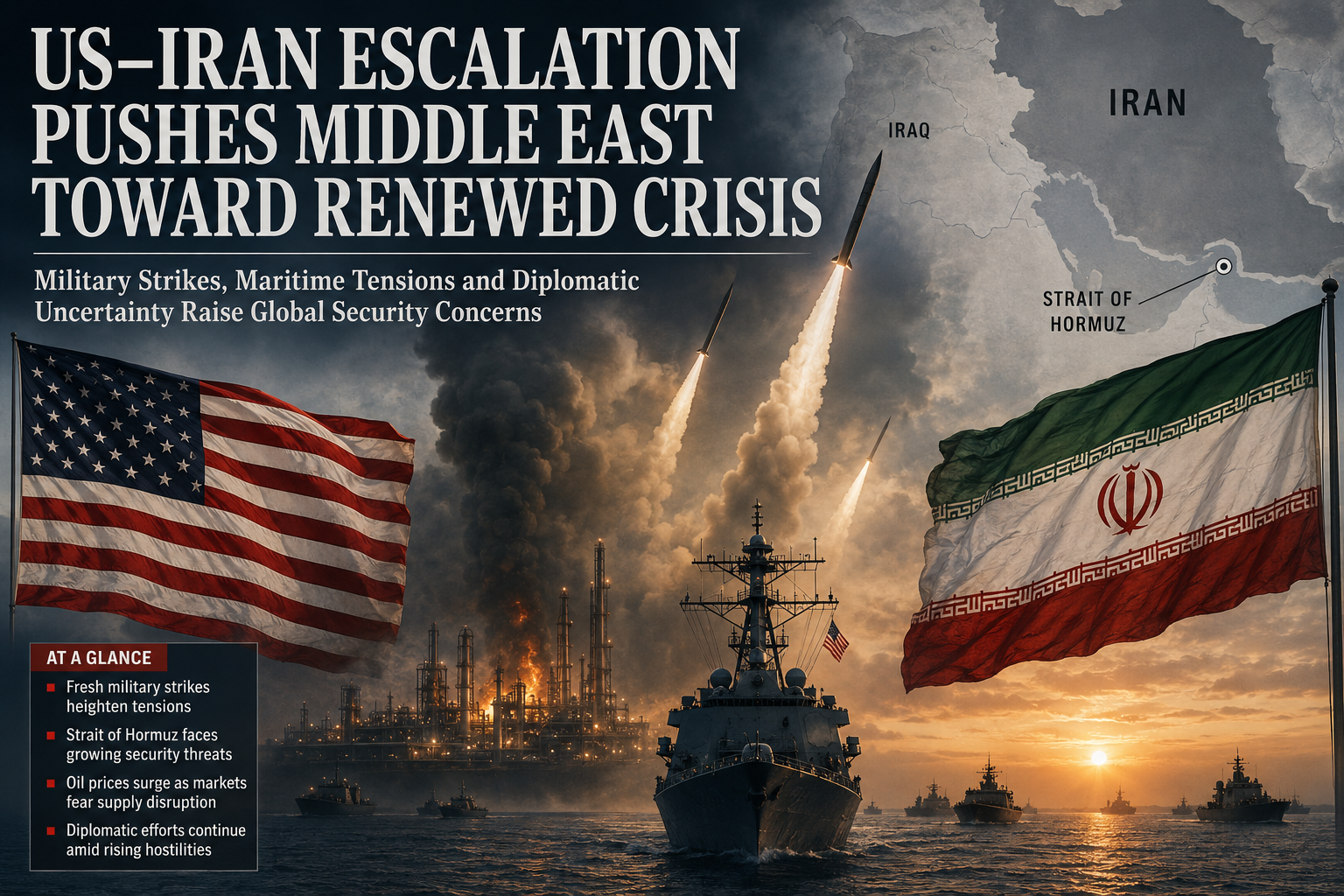
US–Iran Escalation Pushes Middle East Toward Renewed Crisis
Military Strikes, Maritime Tensions and Diplomatic Uncertainty Raise Global Security Concerns

July 13, 2026
The fragile calm between the United States and Iran has deteriorated sharply following a new wave of military exchanges across the Middle East, renewing fears that the region could slide into a broader conflict with significant global consequences. Fresh strikes targeting military installations and retaliatory operations have heightened tensions around the strategically vital Strait of Hormuz, placing international shipping, energy markets and regional security under renewed pressure.
According to multiple international reports, the United States has carried out additional military operations against Iranian-linked targets after accusing Tehran of threatening international maritime security and regional stability. Iran responded with missile and drone attacks directed at military facilities hosting U.S. forces in parts of the Gulf, while also maintaining a more assertive military posture around the Strait of Hormuz. The latest exchanges have intensified concerns over the security of one of the world’s busiest energy corridors.
The Strait of Hormuz remains central to the confrontation. Nearly one-fifth of the world’s seaborne oil trade typically passes through the narrow waterway, making any disruption an immediate concern for global energy markets. Shipping activity has slowed significantly amid security threats, while insurers and commercial operators continue to assess operational risks. Oil prices climbed sharply following reports of renewed hostilities, reflecting investor concerns over possible supply disruptions.
Diplomatic efforts aimed at preserving an interim understanding between Washington and Tehran have also come under increasing strain. International mediators continue to push for renewed negotiations, but repeated military exchanges have weakened confidence in the durability of previous commitments. Analysts warn that while neither side appears to be seeking a prolonged regional war, the risk of unintended escalation remains exceptionally high.
Regional governments have responded by reinforcing air defenses, reviewing emergency preparedness measures and urging restraint. Gulf states remain particularly concerned that continued military exchanges could threaten civilian infrastructure, commercial shipping and broader economic stability. Several international organizations have also renewed calls for dialogue, emphasizing that diplomatic engagement remains the only sustainable path toward de-escalation.
The renewed confrontation is also producing wider geopolitical consequences. Global financial markets have reacted cautiously, energy-importing nations are monitoring fuel supplies, and major powers are closely watching developments that could reshape security dynamics across the Middle East. Continued instability may also influence international trade routes, inflationary pressures and global investment sentiment in the months ahead.
While military activity continues, diplomatic channels have not been completely severed. Officials and international mediators remain engaged in efforts to prevent further escalation and restore negotiations. However, with both sides maintaining firm public positions and military readiness, observers warn that even a limited miscalculation could trigger a broader regional crisis with worldwide economic and humanitarian implications.


