INSIDE THE NUMBERS: The Ledger of a Mirage—How Nepal is Borrowing to Breathe
KATHMANDU — On paper, the macroeconomists at the Ministry of Finance have pulled off a minor miracle. If you look at the official charts released in mid-May 2026, Nepal’s public debt-to-GDP ratio appears to have suddenly plunged from a nerve-wracking 48.04% in mid-April to a much more palatable 45.08% today.

But talk to anyone inside the Public Debt Management Office (PDMO) off the record, and they will tell you the truth: We didn’t pay off our debts. We just changed the math.
On April 28, the National Statistics Office quietly published a heavily revised, upwardly adjusted estimate of Nepal’s gross domestic product. By expanding the size of our economy on paper (the denominator), the government effectively shrank our debt ratio without spending a single rupee.
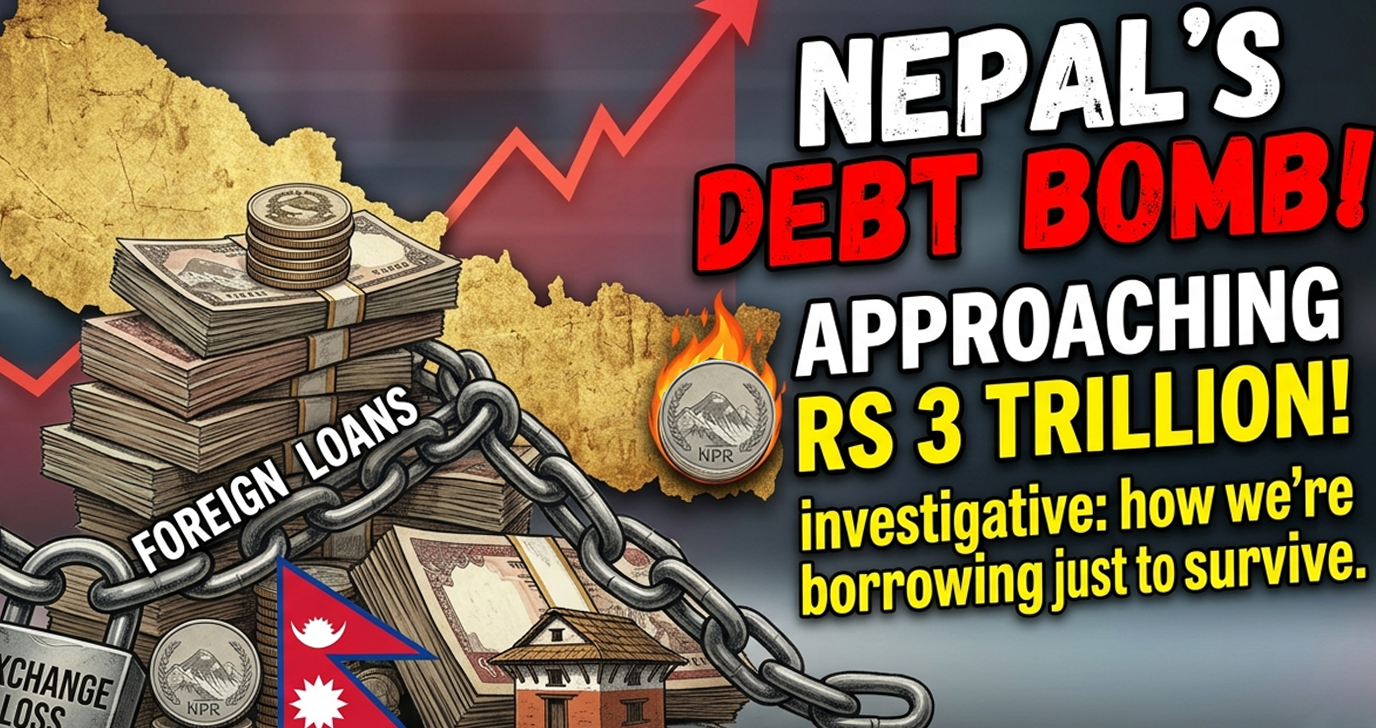
It is a clever accounting trick, but it cannot hide the cold, hard cash reality: Nepal’s actual public debt has reached an all-time high of Rs 2,975.04 billion (Rs 2.97 trillion). We are staring down a historic Rs 3 trillion milestone, trapped in a structural cycle where we are aggressively borrowing new money just to keep from drowning under the weight of our old liabilities.
The Asymmetry of a Fiscal Emergency
To understand how precariously balanced the state treasury is, look at where the government is getting its money.
The annual federal budget set an ambitious target to raise Rs 595.66 billion in loans this fiscal cycle. Ten months in, the government has managed to secure Rs 365.16 billion (61.30% of the target). But the composition of that borrowing reveals a deeply troubling structural failure.
Total Borrowing Raised by Mid-May 2026: Rs 365.16 Billion
┌───────────────────────────────────────────────────────────────┐
│ ■ Domestic Borrowing: Rs 298.67 Billion (81.79%) │
│ □ External Borrowing: Rs 66.49 Billion (18.21%) │
└───────────────────────────────────────────────────────────────┘
External, low-interest funding from multilateral lenders like the World Bank has ground to a near-halt, achieving a measly 28.46% of its annual target. Because our bureaucracy lacks the execution capacity to finish infrastructure milestones required to trigger foreign cash disbursements, the state has weaponized local markets instead.
The government has already drained 82.50% (Rs 298.67 billion) of its entire annual domestic borrowing target.
By vacuuming up liquidity from local commercial banks through relentless issues of Treasury bills and development bonds, Singha Durbar is funding its daily bureaucratic survival at the direct expense of the private sector. This is classic “crowding out”—every rupee channeled into paying government administrative costs is a rupee denied to industries, enterprises, and real job creators.
The Phantom Burden: Rs 167 Billion in Pure Air
Perhaps the most alarming finding in the latest ledger is that Nepal is paying heavily for money it never even got to spend.
More than 70% of Nepal’s foreign debt is denominated in Special Drawing Rights (SDR), and roughly 20% is held in US Dollars. Over the last ten months, the Nepali Rupee has buckled, slipping from around Rs 137 per dollar in mid-July 2025 to nearly Rs 150 per dollar today.
The investigative math here is brutal. According to PDMO tracking, this currency freefall has tacked an astounding Rs 167.75 billion in pure exchange-rate liabilities onto our external debt stack.
The Exchange Rate Penalty: Without receiving a single new dollar, euro, or yen to build a school or pave a highway, Nepal’s foreign obligations swelled by more than Rs 167 billion simply because our currency weakened.
The Servicing Trap: Capital vs. Complicity
Where is this mountain of borrowed cash actually going? If it were flowing into transformative infrastructure, a Rs 3 trillion debt pile might be justified. Instead, the data suggests we are building a classic debt trap.
During these ten months, the government has shelled out a staggering Rs 292.52 billion on principal and interest repayments.
To contextualize that: Debt servicing now gobbles up over 4.23% of our total GDP.
We are currently spending more money paying back bankers and international donors than we are executing on our actual capital development budget. In fact, by April, the state had spent less than a quarter (23.6%) of its capital allocation for the year.
A Direct Call for Intervention
The crisis has reached a point where state oversight bodies are abandoning diplomatic language. The National Natural Resources and Fiscal Commission (NNRFC) recently stepped in with an extraordinary demand: a strict, total ban on utilizing internal loans to cover recurrent administrative and bureaucratic costs.
When a country uses long-term bonds to pay for the fuel, salaries, and allowances of its administrative machinery, it is essentially using a credit card to pay the rent.
Nepal’s public debt has more than doubled in just seven years. While foreign exchange reserves remain cushioned by a record-breaking wall of worker remittances from the Gulf and Malaysia, our domestic fiscal core is hollowed out.
If the incoming fiscal budget continues to rely on domestic debt to keep an bloated bureaucracy comfortable, the Rs 3 trillion milestone won’t just be a number—it will be the moment the trap door swings shut on Nepal’s economic future.