Remnants of Nepal’s first railway
The news of a railway being operated in Chandragiri some 65 years ago sounds quite surprising, even unbelievable. However, the fact remains that during the Rana regime, a railway track was constructed extending about 9 kilometers from Gurjudhara to Teku, and the railway was indeed operational. It is said that the railway even reached some places near Kichhapokhari.

Even today, remnants of the railway track can be found in some local homes.
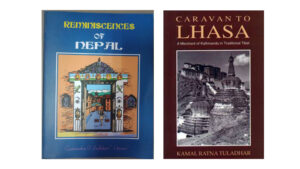
In the book “Reminiscences of Nepal” published in 2060 B.S., the author Gyanendra Prasad Adhikari ‘Hansan’ also mentions about the Matatirtha-Teku railway track. He writes in the preface of the book, “It is true, despite being unbelievable.” Similarly, Kamal Ratna Tuladhar, the author of the book “Caravan To Lhasa,” which narrates the story of struggles of his ancestors engaged in trade in Lhasa, also briefly discusses the railway track in his book.
Hansan has devoted a whole section in his book to discuss the railway track. According to the references in the book, when he was a teenager, he saw smoke rising from four compartments being pulled by a locomotive on that railway track. Curious about it, he approached the vehicle accompanying the Rana companion, and the station master informed him that the railway was being operated from the beginning and it was the locomotive that was pulling the compartments for the last few years.
Since people used to pull it in the beginning and later the bullocks, the locals used to call the railway “Trolley”. Even now, elderly people say, “Here It used to be the first Trolley route,” pointing towards the old road where the railway track existed.
The local, recalls “The Trolley used to come from Matatirtha towards our side to Teku. I remember it as similar to the Janakpur railway. As it was used to carry goods, the compartments behind the locomotive were always open.”
The railway built during the Rana era was Narrow Gazed. After the railway ceased operation, the railway track started to disappear and all the land was encroached, and with next to no remains left it is now hard to say that there used to be a railway in Kathmandu during the Rana era.
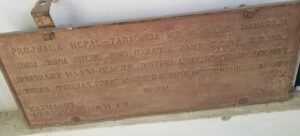
During the tenure of Prime Minister Rana, Shri Teen Bhim Shamsher, the railway was constructed under his administration. Until 2072, there was an old bridge on Vishnudevi (Naikap) located in Balkhu. Especially, that bridge was built for the railway to cross from Matatirtha, and the historic bridge was abandoned and during the the absence of local representatives, the bridge was almost abolished. Chandragiri Municipality Ward No. 15 has managed safeguard the inscribed board of the bridge mentioning all details in the ward office.
Especially, the railway line was built to transport goods brought from the Dhorsing-Matatirtha ropeway (constructed under Chandrashamsher’s administration) to Teku via that railway line. When there was a shortage of food and prices soared in the capital, Chandrashamsher initiated the construction of the Raxaul-Amlekhganj railway line in the decade of BS 1980.
Chandra Shamsher not only constructed the railway, he also constructed the motor road connecting Amlekhganj to Bhimfedi. After the construction of railway and road networks, it became easier to transport food produced in the Terai and other goods purchased from India to Bhimfedi via those routes. From Bhimfedi, the goods were to be transported via porters, that is why Chandra Shamsher saw the need for a ropeway, and construction of the ropeway connecting Hetauda and Bhimfedi to Kathmandu (Matatirtha) was also initiated.
Chandra Shamsher entrusted his nephew Padma Shamsher Rana with the responsibility of constructing the Dhorsingh-Kathmandu ropeway. According to his private secretary Rammani Acharya Dixit, mentioned in his memoir book “Purana-Samjhana,” Padma Shamsher was also given the leadership role in the construction of the Raxaul-Amlekhganj railway line. The responsibility for the construction of the railway line and ropeway was given to the Kolkata-based Martin & Co.
A customs warehouse was established at the final point of the Dhorsingh-Matatirtha ropeway. The goods brought by the ropeway were stored there. The customs house where the goods brought by the ropeway were stored during the time of Chandra Shamsher is still referred to as “Custom House No. 10”.
After Chandra Shamsher, Bhim Shamsher, the father of Padma Shamsher who was empowered with the construction of railways and ropeways, became the ruler, a 9-kilometer-long railway line was constructed from Matatirtha to Kathmandu.
The railway from Matatirtha to Teku was divided into two sections: Matatirtha-Balkhu (above the current Bhatbhateni Supermarket area) and Balkhu to Teku Bhansar. The railway started from the current location where the rail route begins. From Teku, the railway went all the way to the empty rail yard.
There were a total of 80 employees working on the railway. Among them, 20 employees were stationed at the final stop of the railway line, Teku Bhanjyang. Similarly, 20 employees were stationed at Number 10 (Matatirtha), 20 employees stationed at Teku Bhanjyang for railway track maintenance and another 20 employees to assist in carrying heavy loads brought by the ropeway to the railway.
The drivers operating the trains were brought from India. The construction of the Tribhuvan Rajpath as completed with Indian assistance
After running for 30 years, the Matatirtha-Teku freight railway service was discontinued due to three reasons.
After gaining independence from British rule in 2007, India started to pay more attention to Nepal, especially after the political changes in 2018. The construction of the Tribhuvan Rajpath with Indian assistance was completed in 2013, connecting Bhaise to Thankot. Prior to this, there were only motor vehicles running up to Thankot. This construction made the operation of the Dhorshing-Matatirtha ropeway more convenient.
Following the construction of this road, it became feasible to transport goods from Raxaul-Amlekhgunj via rail to Dhorshing, and then transfer them via ropeway to Matatirtha. It became possible to bring essential goods directly from Amlekhgunj to Kathmandu via the Tribhuvan Rajpath. The construction of the Tribhuvan Rajpath made the Dhorshing-Matatirtha railway line and the trains running there less convenient.
Due to the inconvenience caused by the Tribhuvan Rajpath and the Dhorshing-Matatirtha ropeway, a new ropeway line was constructed with American assistance from Hetauda to Kathmandu’s Teku.
The foundation stone for this new ropeway was laid during the tenure of Prime Minister B.P. Koirala, and it was completed in 2021 B.S.. After the construction of the new ropeway line, goods transported from Amlekhgunj to Kathmandu no longer had to be transferred to Dhorshing. Instead, they could be loaded directly onto the ropeway and transported to Teku Bhanjyang.
This development created a situation where the freight railway operating on the Matatirtha-Teku railway line could not find goods to transport. Since the railway was built to transport goods carried by the ropeway, its operation became impractical once the goods started to be directly transported to Teku Bhanjyang via the ropeway.
When this happened, the situation arose where the freight trains operating on the Matatirtha-Teku railway line couldn’t find goods to transport. If the railway was unable to find goods to transport, its operation wouldn’t be viable anymore.
The construction of the Tribhuvan Rajpath and Hetauda-Teku ropeway made this railway section relatively easier to build. However, due to the difficult terrain, plans to give this railway line continuity were made long ago. In 2018 B.S, full operation of the railway on this route was suspended.
After the suspension, the railway engine and freight cars were parked at Teku. Until the 2030 B.S, two railway carriages were seen in the western part of Tundikhel. To enhance the beauty of Tundikhel, small beautiful houses were planned to be built on these carriages. According to experts, these two carriages probably belonged to the railway section from Matatirtha to Teku.
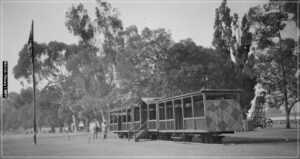
(Railway Carriage placed at Tundikhel, Photo Coutesy : British Library)
Even though the railway engine and carriages were stationed at Teku, railway tracks were left deserted for more than 40 years, according to informants. During the Rana period, there was evidence that railways ran in Kathmandu, and to back evidence ‘track route’ connecting Kalanki-Sunar Gaun- Kuleswor still remains. And also the track could be found in on the maps made in the 2021 B.S. survey conducted in that area.