Powerful 7.1-Magnitude Earthquake Strikes Japan, Triggering Major Rescue Operation
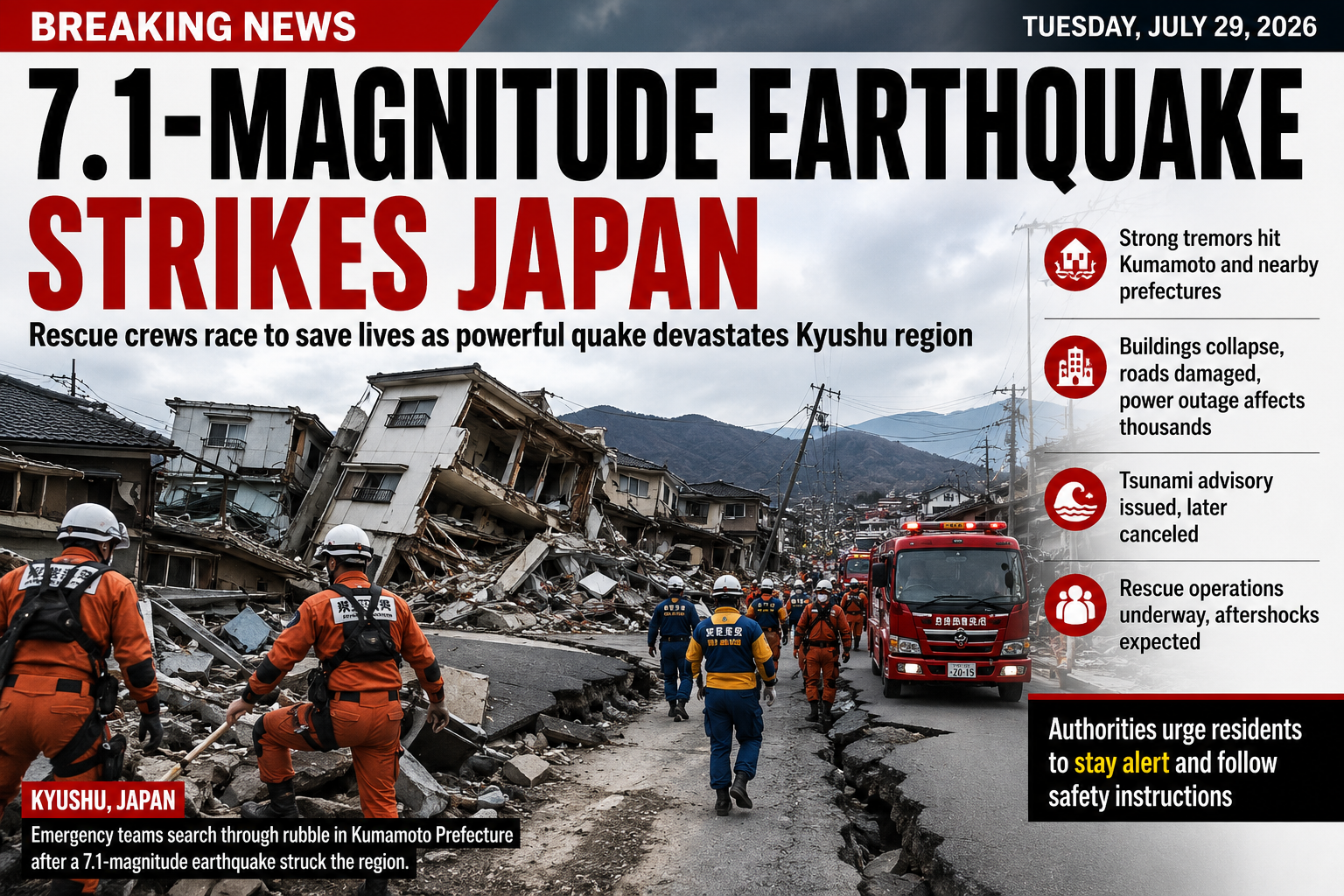
TOKYO — A powerful 7.1-magnitude earthquake struck Japan’s southern Kyushu region, sending strong tremors across Kumamoto and neighboring prefectures, causing widespread damage to homes, roads, and public infrastructure while prompting a large-scale national emergency response.

According to Japanese authorities, the earthquake originated at a relatively shallow depth near Uki City in Kumamoto Prefecture, intensifying ground shaking across the region. Residents described violent tremors lasting several seconds as buildings swayed, power lines collapsed, and debris scattered across streets. The quake was felt hundreds of kilometers away, including in parts of western Japan, raising immediate concerns over structural safety and potential secondary disasters.
Emergency services were deployed within minutes of the earthquake. Firefighters, police officers, medical teams, and members of the Japan Self-Defense Forces launched extensive search-and-rescue operations in heavily affected communities where residential buildings, commercial facilities, and public infrastructure sustained significant damage. Rescue personnel worked throughout the day and night to locate survivors trapped beneath collapsed structures, using specialized equipment and trained search dogs to navigate unstable debris.
Authorities confirmed multiple casualties and dozens of injuries as hospitals activated emergency response protocols to accommodate an influx of patients. Temporary evacuation centers were established in schools, community halls, and public buildings to shelter thousands of residents displaced by the disaster. Local governments urged citizens to remain calm while following evacuation guidance issued through emergency broadcasting systems.
Transportation networks across Kyushu experienced major disruptions. Sections of the Kyushu Shinkansen high-speed rail service were suspended to allow engineers to inspect tracks, tunnels, and bridges for possible structural damage. Road closures affected several highways after cracks and landslides blocked key routes, complicating rescue operations in mountainous areas. Flights at regional airports were temporarily delayed or canceled while safety inspections were conducted.
Electricity and communication services were interrupted across thousands of households as utility companies worked to restore power. Water supply systems in several municipalities also reported temporary outages, prompting authorities to distribute bottled water and emergency supplies to affected communities.
Japan’s Meteorological Agency initially issued a tsunami advisory for portions of the southern coastline immediately following the earthquake. Although minor sea-level fluctuations were recorded, officials later canceled the advisory after determining that no destructive tsunami had developed. Nevertheless, residents in coastal communities were advised to remain vigilant until authorities confirmed that conditions had fully stabilized.
Seismologists warned that strong aftershocks remain likely over the coming days, increasing the risk of additional building collapses and landslides, particularly in areas already weakened by recent seasonal rainfall. Officials urged residents to avoid entering damaged buildings until structural inspections are completed and to keep emergency supplies readily available.
Prime Minister Sanae Takaichi expressed condolences to the families of those affected and pledged the full support of the national government. Additional emergency personnel, engineering units, and disaster relief resources were dispatched to the region to accelerate rescue operations, restore critical infrastructure, and assist local authorities with recovery efforts.
Japan, one of the world’s most earthquake-prone nations, maintains some of the most advanced seismic monitoring systems and strictest building standards globally. While these measures have significantly reduced the impact of major earthquakes over recent decades, officials emphasized that the latest disaster serves as another reminder of the country’s continuing vulnerability to powerful seismic events along the Pacific Ring of Fire.
As rescue efforts continue, the focus remains on locating survivors, restoring essential services, and ensuring the safety of affected communities. Authorities continue to monitor aftershock activity closely while urging the public to rely on official updates and remain prepared for further seismic activity.