Trump’s Beijing Summit: Power Politics, Corporate Diplomacy and the New Era of U.S.–China Relations
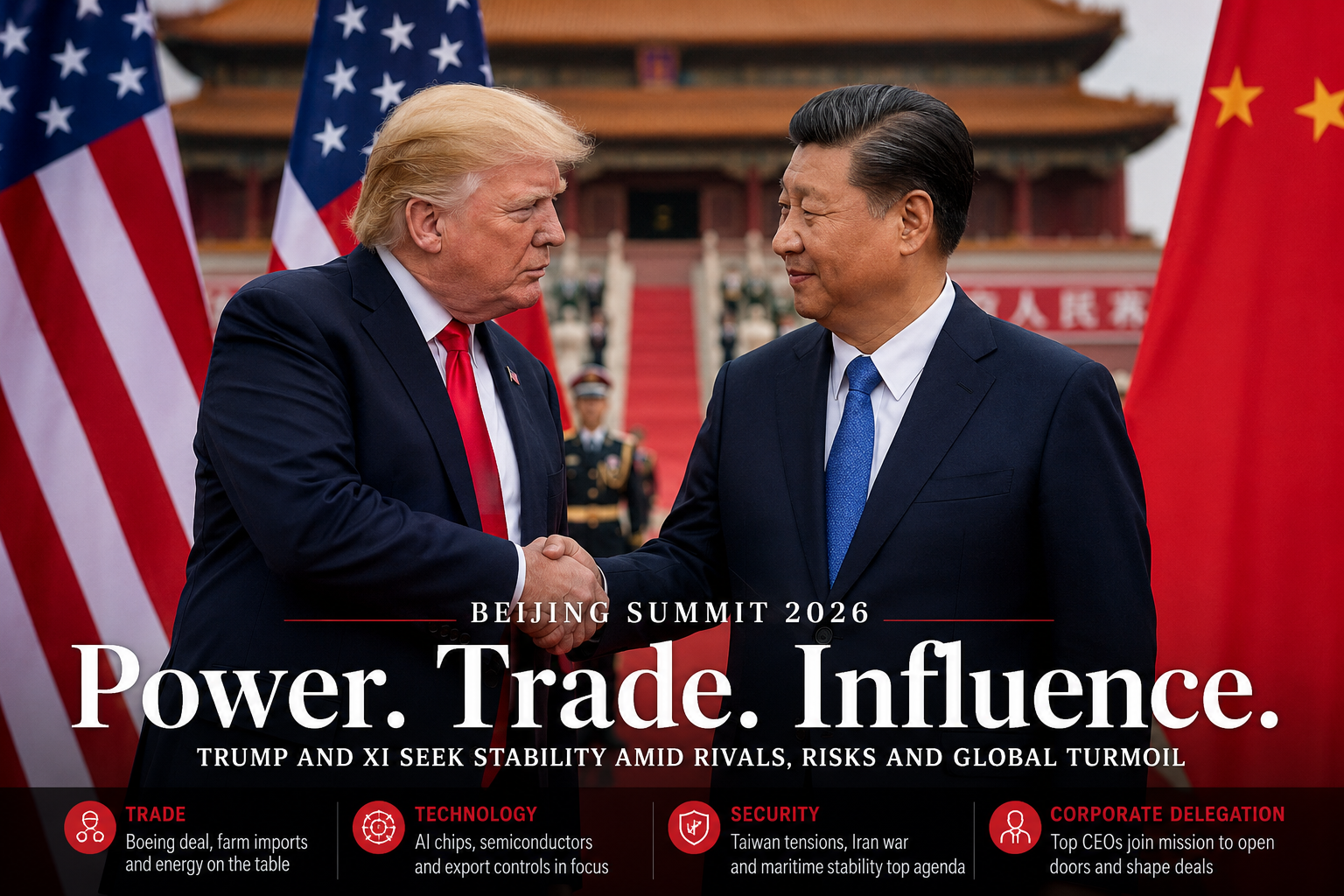
The high-profile state visit of U.S. President Donald Trump to China this week has rapidly evolved beyond a traditional diplomatic engagement into one of the most consequential geopolitical and economic summits of 2026. Hosted by Chinese President Xi Jinping, the two-day meeting comes at a moment when global markets, security alliances, and technology supply chains remain under intense strain from the Iran conflict, semiconductor restrictions, and growing tensions surrounding Taiwan.

What makes this summit historically significant is not only the return of presidential diplomacy between Washington and Beijing after nearly a decade, but also the unprecedented presence of America’s corporate elite inside the diplomatic delegation itself. Executives from major American companies including NVIDIA, Apple, Tesla, Boeing, BlackRock, Visa and Mastercard accompanied Trump to Beijing in what analysts describe as “corporate diplomacy at the highest level.”
Among the most closely watched figures was Jensen Huang, whose inclusion in the delegation signaled Washington’s strategic focus on artificial intelligence, semiconductors, and advanced computing exports. NVIDIA has faced prolonged restrictions and regulatory hurdles in selling high-performance AI chips to Chinese buyers, making Huang’s presence deeply symbolic of the growing fusion between technology competition and statecraft.
Meanwhile, Elon Musk and senior executives from aerospace, banking, biotechnology, and digital payments sectors joined discussions aimed at unlocking approvals, investments, and market access inside the world’s second-largest economy. Reports from diplomatic and financial circles indicated that several participating companies were invited only if they had a clear economic agenda capable of producing measurable commercial outcomes from the summit.
Diplomatically, the summit reflects a calculated attempt by both powers to stabilize relations without fundamentally resolving their rivalry. Trump entered Beijing under mounting domestic pressure stemming from inflation concerns, geopolitical instability linked to Iran, and economic uncertainty surrounding global supply chains. Xi, by contrast, arrived with comparatively stronger centralized political leverage and a slower but tightly managed economic environment. International analysts believe this imbalance shaped the negotiating atmosphere throughout the visit.
Trade remained the dominant issue during the talks. The United States pushed for increased Chinese purchases of American aircraft, agricultural products, energy exports, and advanced industrial equipment as part of Trump’s long-standing effort to reduce the bilateral trade deficit. Negotiations involving Boeing aircraft purchases became one of the summit’s most closely monitored commercial developments due to their symbolic and economic importance for both nations.
However, the most strategically sensitive discussions extended far beyond economics. Taiwan once again emerged as the principal geopolitical flashpoint. Beijing reportedly warned Washington against expanding military cooperation or arms sales to Taipei, while American officials reaffirmed commitments under U.S. law to assist Taiwan’s self-defense capabilities. The Taiwan issue continues to represent the single greatest source of potential military confrontation between the world’s two largest powers.
The ongoing Iran conflict also added urgency to the summit. With global oil markets vulnerable and maritime trade routes facing heightened risks, both Washington and Beijing share a strategic interest in preventing broader instability in the Strait of Hormuz. Diplomatic observers believe Trump sought Chinese cooperation in influencing Tehran toward negotiations, while China attempted to reinforce its image as a stabilizing global power capable of balancing Middle Eastern tensions through diplomacy and economic leverage.
Another defining feature of the visit was the visible integration of corporate leadership into diplomatic strategy. Unlike earlier U.S.–China summits focused heavily on symbolism and broad declarations, this mission appeared structured around highly practical negotiations involving artificial intelligence, semiconductor supply chains, finance, aviation, biotechnology, strategic minerals, and industrial manufacturing. The participation of CEOs navigating export controls, sanctions, and regulatory disputes highlighted how multinational corporations have increasingly become instruments of geopolitical influence.
Security concerns also shaped the delegation’s conduct throughout the visit. Several reports suggested American officials and business executives relied on temporary electronic devices and restricted digital communications due to longstanding cybersecurity concerns involving surveillance and industrial espionage. The precautions underscored the growing technological distrust defining the modern U.S.–China relationship despite simultaneous economic interdependence.
Politically, Trump attempted to project strength, deal-making capability, and economic leadership ahead of upcoming domestic political battles in the United States, emphasizing investment opportunities and his personal relationship with Xi Jinping. Chinese state media, meanwhile, portrayed the summit as evidence of China’s expanding diplomatic centrality during a period of Western geopolitical uncertainty. Both leaders publicly emphasized stability and cooperation, yet beneath the carefully choreographed ceremonies remains an increasingly competitive struggle over technology leadership, military influence, industrial dominance, and the future balance of global power.